Breed guide · Dachshund specialists
What Is a Dachshund? The Complete Breed Guide
A badger hound in a companion dog's body: bold, loud, devoted and built long. This is the honest version, including the back, the barking and which size Singapore flats are actually allowed.
Nelson and Kim, Curious Tails · AVS licence AS24J00046
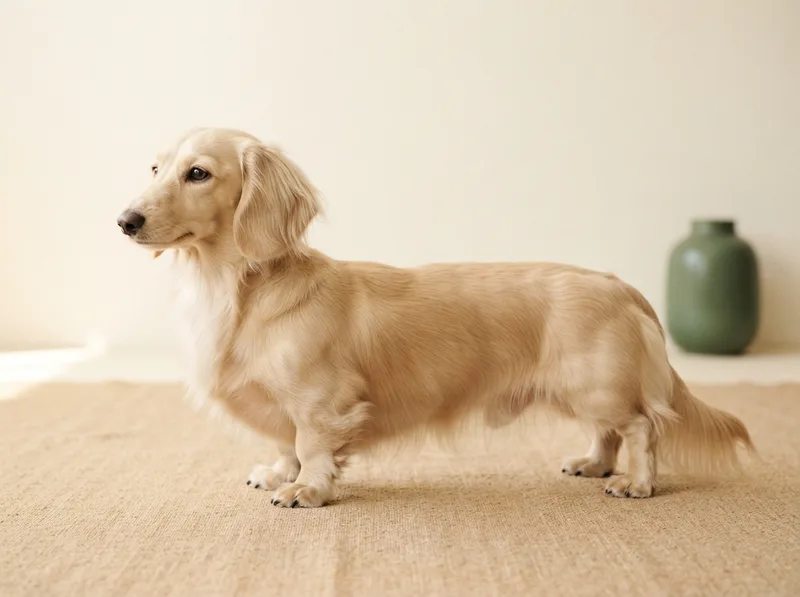
What is a Dachshund?
A Dachshund is a German scent hound with a long body and short legs, bred to follow badgers and other burrow-dwelling animals underground. The name is German for "badger dog". It comes in two sizes, Standard and Miniature, and three coat types: smooth, long-haired and wire-haired.
The Dachshund at a glance
Every dachshund breed guide buries these numbers in a sidebar, and the registries quietly disagree with each other. Here they are up front, with the local price no overseas guide can give you.
One caution before the figures: adult weight is the only honest measure of size, and a nine-week-old puppy tells you nothing about it. Dachshund adult weight is set by the adult weight of both parents, and miniature dachshund size only proves itself once the dog stops growing.
<5kg
Miniature adult weight
7-15kg
Standard adult weight
12-16 yr
Lifespan, commonly cited
$4,288–$4,888
All-in, here in Singapore
Where the shape comes from: a badger dog with a job
The Dachshund dog breed is a working scent hound from the hound group whose body was engineered for a single task: following a badger down its own tunnel. Dachs means badger and Hund means dog, which makes the breed name a plain job description. In Germany it is still called the Teckel or Dackel.
The long spine and short legs are not a stylistic quirk or a modern exaggeration. They are working equipment, built to fit a burrow and keep digging once inside. Bred to hunt badgers below ground, the same dogs were also used above ground for tracking wounded game, per the Kennel Club breed standard.
Understanding the job explains almost everything owners later find surprising. A dog sent underground alone had to make its own decisions, which is why the breed reads as stubborn rather than disobedient. It had to bark continuously so a handler above could locate it, which is why the voice is enormous for the body. And it had to want to dig, chase and follow a scent line, which is why the dachshund digging instinct still turns up in a flat, aimed at the sofa cushions.
None of that has been bred out. You are getting a hunting dog in a companion-sized package, and the instincts arrive switched on.
The long back is not a design flaw. It is a tunnel tool that now lives in a flat.
The two sizes, and the conflicting numbers reconciled
The standard vs miniature dachshund question is the first fork in the road: those are the two recognised dachshund size classes. The complication is that the major registries publish different figures for the same dog, which is why you will find three different answers in the first three search results.
The table below reconciles them. Where sources genuinely differ we say who says what, rather than picking one silently and presenting it as settled fact.
A dog that lands between the two classes is often called a tweenie dachshund by owners. It is every inch a Dachshund; it simply is not a Miniature, and in Singapore that distinction has legal consequences we cover further down. The full breakdown lives in the standard and miniature size guide.
| Miniature | Standard | |
|---|---|---|
| The Kennel Club | Preferably under 5kg | Not weight-capped |
| American Kennel Club | 11lb and under (about 5kg) | 16 to 32lb (about 7 to 14.5kg) |
| Greencross Vets | Up to 5kg | 7 to 15kg |
| Shoulder height | 13 to 18cm at the shoulder | About 35cm at the shoulder |
| Adult size settles | Adult size by 12 months | Adult size by 12 months |
Kaninchen and teacup: labels, not size classes
Two labels sit below the Miniature in Singapore listings, and only one of them is real. The kaninchen dachshund ("rabbit") is a genuine FCI size class in Europe, around 3.5kg, measured by chest circumference for hunting purposes. It is real taxonomy, but neither the AKC nor the Kennel Club recognises it as a separate size, and in the local pet market it mostly functions as a premium label.
The teacup Dachshund is not a size class anywhere. It is a marketing word. When it carries a price premium it usually signals a runt bred small at the cost of health: fragile bones, low blood sugar, and a frame even less able to protect the famous back.
Honestly, this is one of the few places where I will tell a buyer to stop reading the listing and start asking questions. A size label is not a health credential. Ask for the adult weights of both parents instead, out loud, in kilograms.
Before you pay a premium for smallness
- Kaninchen: a real FCI class, but not a health upgrade and not a product tier here
- Teacup: pure marketing, and often a health red flag
- A premium beyond Miniature buys risk, not rarity
- Ask for both parents’ adult weights rather than accepting a label
The three coats: smooth, long-haired and wire-haired
Dachshund types divide along two axes: size, and coat. There are three coat types, and both sizes come in all three. The coat changes the grooming load and the look, not the personality underneath.
The smooth coat Dachshund is short and dense, and asks the least of you. Long-haired carries feathering on the ears, chest, legs and tail, and needs regular brushing to stay free of mats behind the ears and in the trouser feathering. Wire-haired has a harsh topcoat and a beard, and traditionally needs hand-stripping rather than clipping.
Grooming by coat type is the practical difference, and the Kennel Club puts weekly grooming as the baseline for the breed. Long-haired owners in a humid climate should read that as a floor rather than a ceiling, particularly around drying properly after a bath. There is more detail in the three Dachshund coat types explained.
What we actually place
- Roughly 80% long-haired, 20% smooth
- No wire-haired: we cover it as education only
- Long-haired cream is the single most requested combination
- Grooming guidance: about weekly, more for long coats
Colours, and the one pairing responsible breeders avoid
Dachshund colours run from the cream Dachshund and red through black and tan, chocolate and tan, and the mottled dapple pattern. Google’s own breed panel lists black, black and tan, chocolate and tan, blue and tan, chocolate and cream, cream, tan and red.
A single dapple, produced when one parent is dapple and the other is not, is a normal, healthy dog. A double dapple, produced by dapple to dapple breeding, is a different matter: the double dapple risk is serious: congenital deafness and blindness, plus eye defects such as microphthalmia.
This is not a fringe opinion. The Kennel Club registration ban has refused puppies from two dapple parents since 1 January 2010, citing the associated risks of impaired vision and hearing. We do not sell double-dapples, and no colour is worth a puppy’s hearing or sight. Our full position is on why we will not sell a double dapple.
The dapple question, plainly
- Single dapple with one non-dapple parent: safe, and we place them
- Double dapple from dapple x dapple: deafness, blindness and eye-defect risk
- Kennel Club registration refused for dapple-to-dapple litters since 1 January 2010
- "Rare colour" pricing is a red flag, not a premium
Temperament: the big dog in a small body
The Dachshund personality is bold, comic, stubborn and completely devoted, and dachshund characteristics are remarkably consistent from dog to dog. Google’s breed panel lists it as playful, clever, lively, stubborn, independent, devoted, active and courageous, and that is a fair summary of a dog that has no idea how small it is.
Ask owners and you get the same picture in funnier language. A thread on the r/Dachshund community this July, with more than 8,700 upvotes, turned into a long list of people describing a five-kilo dog that is absolutely certain it is a ninety-pound guard dog. That gap between self-image and shoulder height is the breed in one sentence.
What that means at home: greeting ceremonies at the door, blanket burrowing under every throw in the flat, supervision of all cooking from floor level, and an alarm system with opinions. Devotion is total. This is a dog that treats your household as its life’s work, and it does not enjoy being left out of things. The longer character sheet is on the character sheet in full.
Small dog, big opinion. Nobody has told the Dachshund about the size difference.
Do Dachshunds bark a lot?
Yes. Dachshund barking is not a defect in this breed, it is the job description: a badger hound was bred to bark continuously underground so a handler could find it, and the volume is disproportionate to the body.
Training moderates it. Training does not delete it. Anyone who promises you a quiet Dachshund is selling rather than advising, and HDB corridor barking from an alert barker matters far more than the size of the dog.
This is the second question I ask any household before recommending the breed, right after the back question: can you, and your neighbours, live with a proper alarm bark? If the honest answer is no, the breed is wrong for the home, and it is far kinder to find that out now than after the puppy arrives.
Are Dachshunds high maintenance?
A Dachshund is low maintenance on grooming and high maintenance on attention. The costs are behavioural and structural rather than cosmetic.
Exercise sits at up to about an hour a day per Kennel Club guidance, and a dachshund daily walk should feed the nose rather than just the legs, which is where the mental stimulation comes from. A scent hound that has not used its nose all day will find its own entertainment, usually somewhere expensive.
The real ongoing work is the back-safe routine below and the company this breed expects. On grooming alone, a smooth Dachshund is one of the easier small dogs you can own.
The back: IVDD is the breed’s defining health risk
Intervertebral disc disease, almost always shortened to IVDD, is the dachshund health problem that defines the breed. IVDD in Dachshunds affects approximately 25%, about 1 in 4 Dachshunds. That figure comes from two independent sources that agree: the Dachshund Breed Council’s IVDD resource and Greencross Vets, who state that around 25% suffer back problems.
The mechanism is the same dwarfism trait that gives the breed its shape. Spinal disc calcification starts early, leaving the discs vulnerable to rupture, and a long back gives them more leverage to work against.
Nobody can promise prevention, and you should be sceptical of anyone who does. What you can do is reduce risk and design daily life around the spine, starting the week the puppy comes home. Our complete treatment is in our full IVDD and back-care guide.
Emergency signs: go to a vet immediately
- Sudden hind limb weakness, wobbling or crossed legs
- Dragging the back legs, or sudden inability to stand
- Yelping when picked up, or a hunched, rigid back
- Loss of bladder or bowel control
- These are emergencies. Do not wait to see if it settles overnight.
The four habits that shape a back-safe household
Back safe living comes down to four habits, and they are far easier to install at nine weeks than to retrofit at three years. We walk every buyer through them at handover.
None of these guarantee anything. Together they remove the everyday impacts that a calcified disc is least able to absorb, which is the only part of the equation an owner actually controls.
The four habits
- Ramps not stairs, at every height the dog routinely uses
- Harness not collar: a Y-shaped harness for any lead pressure
- Keeping a Dachshund lean, because obesity multiplies the risk
- No jumping on or off furniture, taught from the first week
The other health conditions worth knowing
Beyond the back, the conditions vets most often associate with the breed are patella luxation (a slipping kneecap), dental disease and crowding in a small jaw, and eye conditions including progressive retinal atrophy and cataracts, managed through routine eye screening.
Obesity in Dachshunds deserves its own line because it is the multiplier behind several of the others. A lean Dachshund is doing simultaneous preventive work on its spine, its knees and its lifespan.
How long do Dachshunds live? On dachshund lifespan the sources agree for once: commonly cited 12 to 16 years, per both Google’s breed panel and Greencross Vets. This is a long-lived breed. The back, not the lifespan, is the thing to plan around. More detail sits in lifespan and health in detail.
Which Dachshund is legal in an HDB flat
This is the single question no overseas breed guide answers, and in Singapore it decides whether you can own the dog at all. Item 19 of the HDB approved breed list reads "Dachshund (Light or Miniature)". The Miniature is the HDB approved dog here, named outright. The full-size Standard is absent from the 62 breed list.
The rest of the rule matters too: one approved dog per flat, with a fine up to $4,000 for breaches, under the Housing and Development (Animals) Rules. You can read the list yourself on HDB’s approved breed list.
Private housing works differently. Condominiums and landed homes follow AVS limits of ownership and the estate’s own by-laws, which is why both sizes are legal there. The full wording, with the exact source, is on the exact HDB rule for Dachshunds.
The HDB position in short
- Miniature Dachshund: approved, item 19
- Standard Dachshund: not on the approved list
- One approved dog per flat
- Fines up to $4,000 for breaches
- Condo and landed: AVS limits apply instead
Licensing, in the order it actually happens
An AVS dog licence is mandatory in Singapore, and the fee depends on the dog’s age and whether it has been sterilised. A puppy going home at around nine weeks is comfortably under five months, so the first licence is the cheapest tier.
First-time owners are also directed to the AVS pet ownership course. We complete the licensing paperwork at the point of purchase, so it is done before the dog reaches your flat rather than left as homework.
| Situation | Fee |
|---|---|
| Under 5 months | $13.50 per year |
| Above 5 months, unsterilised | $81 per year |
| Above 5 months, sterilised | $13.50 per year |
| Above 5 months, sterilised (one-time) | $35 lifetime licence |
Living with a Dachshund in Singapore, day to day
A Dachshund carries its chest a few centimetres off the ground, which changes how this breed experiences a tropical city. Singapore heat and humidity make hot pavement walks the daily hazard, because pavement and void-deck concrete hold heat long after the sun drops, and a dog this low sits in that radiant heat rather than above it. Walk early or late, and check the ground with the back of your hand before you commit to a route.
Flat living brings the barking question into daily focus. Shared corridors, lift lobbies and void decks mean a steady stream of passing strangers, and an alert hound will announce every one of them until taught otherwise. For a flat sized dog this is the practical constraint in an HDB, not the floor area.
Humidity is the other local factor. A long-haired Dachshund that is not dried properly after a bath or a rainy walk stays damp against the skin in the feathering, which is uncomfortable and avoidable with a few extra minutes and a towel.
Is a Dachshund a good pet?
Yes, for a household that wants personality more than obedience. A Dachshund is funny, brave, deeply bonded and genuinely characterful, and owners of calmer breeds tend to be a little envious of the entertainment.
The yes is conditional on two things: tolerance for a loud alarm bark, and a real commitment to back-safe habits. Households that want a quiet dog, instant obedience, or a pet that copes with ten empty hours a day will struggle, and no amount of training changes the underlying design.
We would rather talk someone out of the wrong breed than sell them the wrong dog, which is why the honest downsides get their own section rather than a footnote.
What is the downside of a Dachshund? The honest list
Any honest Dachshund pros and cons list has five entries on the cons side, and all five are permanent features rather than training failures.
The back risk never goes away; you design daily life around it for the dog’s whole life. The barking is loud, frequent and only partly trainable. Stubborn potty training genuinely takes longer than the internet suggests, because stubborn is part of the personality you are buying. The Dachshund prey drive and the digging are instincts, not misbehaviour. And this is not a biddable student: expect negotiation over commands rather than compliance.
If you read that list and found it charming rather than alarming, you are probably the right household. That reaction is a better predictor than any quiz.
The five honest downsides
- IVDD risk shapes daily life permanently
- Loud, persistent barking that training only moderates
- Slow, stubborn potty-training
- Real prey drive and a genuine digging instinct
- Independent thinking that reads as disobedience
Who should not get a Dachshund
Breed matching works better as a filter than a sales pitch. If your flat sits empty ten hours a day, this is not the right dog for you: a Dachshund left alone all day bonds hard and protests loudly, and separation anxiety is common. If you need a quiet dog for close neighbours, the same answer applies.
A first time owner who wants fast, reliable obedience will be far happier with a Poodle. If you want a gentle lapdog for a calm home, a Maltese is the better match. We run four other breed sites and we would genuinely rather send you to the right one.
If you want a small dog with an enormous personality and you can laugh at being outsmarted by something with legs that short, then yes, this is your breed.
A quick if/then
- Empty flat all day, then: not this breed
- Need a quiet dog, then: not this breed
- Want fast obedience, then: consider a Poodle
- Want a calm lapdog, then: consider a Maltese
- Want character and can take a joke, then: Dachshund
How the Dachshund compares to the breeds people weigh it against
Buyers rarely shortlist a Dachshund on its own. Comparing small breeds, the usual set is Dachshund vs Corgi, Dachshund vs Beagle and Dachshund vs Shih Tzu, and each contrast is genuinely different.
The Corgi shares the long-back structure and the herding-bred opinion, but carries a heavier coat and a higher energy demand. The Beagle is the other scent hound in the running, with a similar nose-first brain and a much greater need for space and exercise. The Shih Tzu is a companion breed rather than a working one, which makes it the gentler choice for a quiet home.
Head-to-head detail on all three sits in how the Dachshund stacks up against other small breeds.
How to verify any Dachshund seller in Singapore
Verify, do not trust, and apply this to us as readily as to anyone else. Every legitimate shop appears on the public registry of AVS licensed pet shops. Ours is licence AS24J00046, and you should look it up rather than take our word for it.
The stakes are real. Unlicensed sellers typically deal in smuggled puppies without proper veterinary care, and parvovirus is the common outcome. A single parvovirus treatment can run $5,000 to $10,000 or more with no guarantee the puppy survives, against the $500 to $1,000 that looked like a saving. One buyer has been fined $7,000 by NParks for purchasing a smuggled dog.
At the viewing, ask three things: the adult weights of both parents, whether you can see or video-call those parents, and to see the health paperwork. A seller with a genuine Miniature programme answers in seconds and reaches for numbers. A seller with a story changes the subject to how tiny the puppy looks today.
What should come with any puppy
- Vet health check
- Vaccination records
- Microchip
- Breed identification
- A licence number you can verify on the AVS registry
Go deeper on any part of the breed
Frequently asked questions
Is a Dachshund a good pet?
Yes, for a household that wants personality over obedience. Dachshunds are devoted, funny and brave. The conditions are a tolerance for loud barking and a real commitment to back-safe habits: ramps, a harness, lean weight and no furniture jumping.
Are dachshunds high maintenance?
Low maintenance on grooming, high on attention. Exercise runs up to about an hour a day per Kennel Club guidance. The real work is the back-safe routine and the company this breed expects, not the coat.
What is the behavior of a Dachshund?
Bold, loud, stubborn and intensely devoted, with a working nose still driving the dog. Google lists the breed temperament as playful, clever, lively, stubborn, independent, devoted, active and courageous, which owners tend to agree is accurate.
What is the downside of a Dachshund?
The IVDD back risk that shapes daily life permanently, loud persistent barking, slow potty-training, a real prey drive and digging instinct, and independent thinking that reads as disobedience. All five are permanent features, not training failures.
How do you pronounce dachshund?
How to pronounce Dachshund: in Singapore and most English-speaking countries the dachshund pronunciation is "DAKS-hund". The German original is closer to "DAHKS-hoont". Both are widely understood; nobody will correct you at the vet.
Why are Dachshunds called sausage dogs?
The nickname describes the silhouette: a long body on very short legs. "Wiener dog" and "doxie" are the American versions of the same joke. The real name is German for badger dog, which describes the job rather than the shape.
Are Dachshunds good with children?
They generally suit families with older children who can be taught to support the back and never let the dog jump down from a lap or sofa. Very young children who pick dogs up and drop them are a poor match for a breed with this spine.
Do Dachshunds shed?
Yes. Dachshund shedding happens across all three coats. Smooth coats shed short hairs year round, long coats shed more visibly and need weekly brushing, and wire coats shed least but need hand-stripping. No Dachshund is hypoallergenic.
Meet your Dachshund
Come say hello at Balestier
2 Balestier Road #01-701, Singapore 320002 · Weekdays 12pm–6pm · Weekends 10am–6pm. Or message us first: tell us about your home and routine, and we'll tell you honestly if a Dachshund fits.
Ready to meet one?
See the Miniature Dachshunds available right now, with coat, colour and all-in price on every card.
See available Dachshund puppies