Training honesty · Months, not weeks
Potty Training a Stubborn Dachshund
House training this breed is a marathon the internet keeps advertising as a sprint. Here is the honest timeline, the schedule that actually shortens it, and the one tray rule from our placements that saves months.
Nelson and Kim, Curious Tails · AVS licence AS24J00046
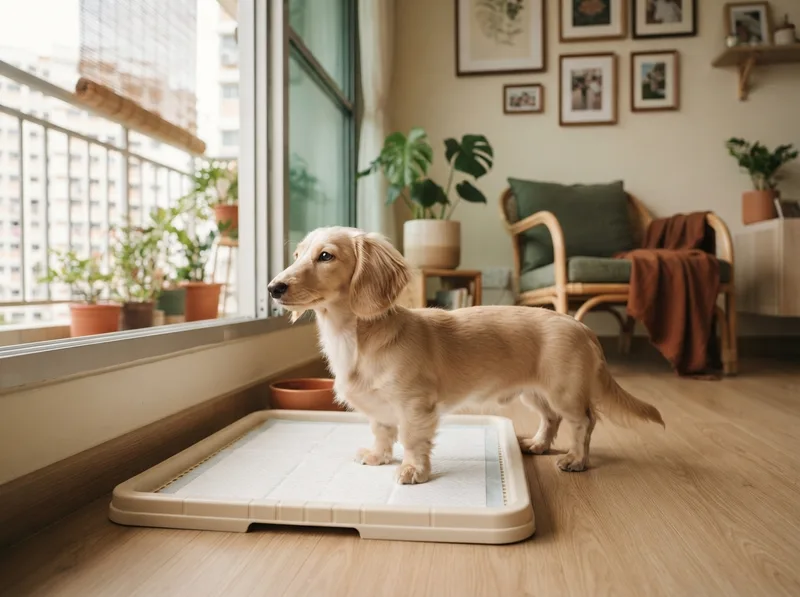
How long does it take to potty train a Dachshund?
Four to eight months to genuine reliability, honestly, with a normal regression around adolescence. The method: trips to one permanent toilet spot after every wake, meal and play session plus every two hours, a treat within two seconds of success, silent enzyme cleanup of accidents, and a tray location that never, ever moves.
The honest potty timeline
The internet promises house-trained puppies in two or three weeks, and dachshund potty training laughs at the internet. Real reliability in this breed lands between four and eight months, with steady progress before that and a famous adolescence regression around six to eight months that means nothing except hormones and hound. Owners who know the timeline in advance experience a normal process; owners who expected week three experience despair, and despair makes people inconsistent, which is the one thing that genuinely delays the result.
Why the breed is slow at this: the same independence that made a good solo hunter makes a dog that weighs your toilet opinions against its own convenience, and small bladders plus tropical rain refusal add logistics. None of it is intelligence; a Dachshund that has trained its household to hand-deliver snacks understands cause and effect perfectly. It simply files toileting under negotiable until the schedule proves otherwise.
4-8 mo
Realistic reliability window
2 hrs
Baseline trip interval for a young puppy
6-8 mo
The normal adolescence regression
0
Cases improved by punishment, ever
Tray or downstairs: the HDB decision
Flat-dwellers choose between a pee tray in the flat and downstairs grass runs, and the honest answer for a young puppy is both, in sequence. Before vaccinations complete, the tray is the only game anyway. After that, most HDB households run a hybrid: tray for the small hours and workdays, downstairs for the walk-linked business, and the dog eventually develops preferences you will accommodate like the staff you are.
Tray specifics that matter: real grass patches smell like the right answer to a dog and win faster adoption but need weekly replacement; synthetic grass trays wash and persist but demand more diligent rinsing in this climate before they announce themselves. Position beats product, which brings us to the rule this guide exists for.
The never-move-the-tray rule
From a hundred-plus placements, the strongest single predictor of potty-training speed we observe: households that fix the tray location on day one and never move it finish months earlier than households that relocate it, even once, even a metre. This breed maps territory by nose; a moved toilet is not the same toilet in a new place, it is a cancelled agreement requiring renegotiation.
So choose the spot like it is permanent plumbing, because behaviourally it is: the service yard is the classic pick (ventilated, washable, away from food), a bathroom corner works if the door policy is forever-open, and balconies work where they are safe and shaded. Wrong answers: anywhere the household will want back later, anywhere reached through doors that close, and anywhere next to the food station, which offends dogs as much as it would offend you.
The tray commandments
- One location, chosen for forever, on day one
- Never moved: not for guests, not for renovation, not a metre
- Reachable without closed doors, day and night
- Away from food and water stations
- Cleaned with enzyme cleaner, never bleach-scented products
The schedule method, hour by hour
The engine of hdb toilet training is a toilet schedule the human runs, not a signal the puppy sends; the signals come later. Carry or lead the puppy to the spot: after every wake-up, after every meal, after every play session, and every two hours as the baseline. Stand boring, wait, and the instant business concludes, throw a quiet party: a treat within two seconds and calm praise, then freedom. Reward timing is the whole technology, that two-second window; rewards delivered back indoors pay for coming indoors.
Accidents are data, not defiance: they mark the schedule gap you just discovered, and their only correct handling is silent cleanup with an enzyme cleaner so the scent invitation dies. Punishment, rubbed noses, stern lectures: these teach exactly one lesson, that toileting near you is dangerous, which produces a dog that hides behind the sofa to go. That dog is not spiteful; it is trained, by the lecture, to do precisely that.
Night control arrives last, and crate training helps here: a properly-sized sleeping crate leans on the instinct not to soil the den, so expect one 3am carry-out in the early weeks, stretching gradually. Restricting water an hour before bed is fine; restricting it further in this climate is not.
Troubleshooting the famous cases
The rain refusal: a Dachshund contemplating wet grass performs one of the breed’s great dramatic roles. Solutions in escalating order: a sheltered corner of the downstairs run, a rain-tolerant tray on the service yard as the wet-weather annex to the SAME primary spot (an annex is not a move), and accepting that monsoon season is what the tray was always for.
The regression at six to eight months: adolescence, plus marking behaviour beginning in some males. Response: return to the puppy schedule for a fortnight, fuss nothing, and it passes. Marking indoors persisting past sterilisation, or any sudden loss of established control at any age, moves the file from training to medicine: urinary infections are common, easily treated, and exactly the kind of thing the vet finds in one visit. And through all of it, the wider stubborn-hound method in the training pillar applies here too: pay what you want repeated, manage what you cannot yet trust, and never bet against the schedule. It wins in the end, every time, and the first week home guide shows how day one sets it rolling.
Frequently asked questions
How long does Dachshund potty training take?
Realistically four to eight months to true reliability, with a normal regression around adolescence. The famous stubbornness applies to toilets too; the schedule method below shortens the road.
Tray or downstairs: which is better for HDB?
Both, in sequence: tray-only before vaccinations complete, then a hybrid of tray for small hours and workdays plus downstairs runs linked to walks. Fix the tray location permanently on day one.
Where should the pee tray go?
Somewhere permanent, ventilated and always reachable: the service yard is the classic. Never move it once chosen; relocated trays restart the training clock in this scent-mapping breed.
Why the sudden accidents at seven months?
Adolescence regression, entirely normal: hormones renegotiate everything briefly. Rerun the puppy schedule for a fortnight without drama. Sudden loss of control outside that window is a vet visit.
Should I punish accidents?
Never. Punishment teaches the dog that toileting near you is dangerous, producing secret behind-the-sofa artists. Clean silently with enzyme cleaner and tighten the schedule instead.
My Dachshund refuses to go in the rain: help?
Classic breed theatre. Offer a sheltered downstairs corner, keep a covered tray annex at the same primary spot for monsoon days, and lower your expectations of dignity, theirs and yours.
Meet your Dachshund
Come say hello at Balestier
2 Balestier Road #01-701, Singapore 320002 · Weekdays 12pm–6pm · Weekends 10am–6pm. Or message us first: tell us about your home and routine, and we'll tell you honestly if a Dachshund fits.
Day one sets the clock
The first week home guide starts this schedule before bad habits can.
First week home