Buying and beyond · Day by day
The First Week Home With Your Dachshund
A week 9 puppy arrives with no manual and enormous opinions. Here is the first week home as a day-by-day script: the quiet arrival, the pre-decided night policy, the rhythm installation, and the honest pass marks for day seven.
Nelson and Kim, Curious Tails · AVS licence AS24J00046
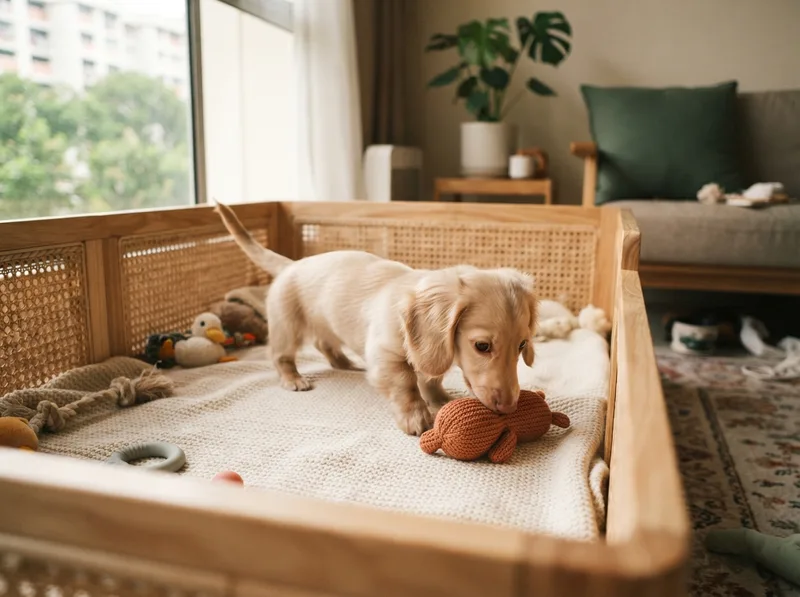
What should the first week with a Dachshund puppy look like?
Quiet and scheduled: day one is toilet-spot-first and visitor-free; nights start near your bed with silent 3am carries; days two to four install the eat-toilet-play-sleep rhythm with 18 to 20 hours of defended sleep; days five to seven widen the world slightly and book the first vet visit and training lesson. Week one’s only job is proving the flat is safe and the routine reliable.
Day one: the quiet arrival
Handover day runs best as the most boring celebration of your life. For our buyers, the logistics are done for you: we deliver, set up the playpen, unpack the starter kit and complete the licence before we leave, which converts day one from a shopping expedition into what it should be: a nine-week-old puppy quietly discovering its four stations while the household pretends not to stare.
The day-one script: toilet spot first, before anything else, and celebrate the inaugural success like it matters, because it does. Then the pen, water, a small meal of the food it already knows (diet changes wait a fortnight), and controlled, gentle floor-level introductions to each resident human. What does not happen on day one: visitors, other pets beyond a scent-swap, car tours, or the extended family photoshoot. A new puppy schedule starts with subtraction.
Day one in six moves
- Toilet spot first, success celebrated quietly
- Pen, water, small familiar meal
- Floor-level hellos, residents only
- No visitors, no grand tours, no other pets yet
- Early night; everyone is more tired than they look
The first night, decided in advance
Puppy crying at night is the first parenting controversy, and the households that suffer are the ones that decide their policy at 2am. Decide now: the pen or crate sleeps in your bedroom or beside it for the first nights, where your breathing is audible, and migrates to its permanent station over a week or two if bedroom-sharing is not the plan. This is not spoiling; it is a nine-week-old’s first nights away from its litter, and proximity is the cheapest settling technology that exists.
The first night mechanics: a warm snuggle toy (the starter kit’s wrapped heat pad substitutes for littermates), a blanket that smells of our nursery, one calm 3am toilet carry conducted like a silent business transaction, and zero play, zero lights, zero lectures. Expect real crying for one to three nights and settling by the end of week one; a puppy still inconsolable beyond that earns a call to the care line rather than a harder policy.
Days two to four: rhythm installation
The middle of the week is routine building: the settling rhythm of eat, toilet, play, sleep, repeat, on a schedule the humans run. The feeding schedule is three to four small meals daily at this age; the toilet schedule runs after every wake, meal and play burst per the two-hour baseline, and, the part first-timers underestimate, 18 to 20 hours of sleep defended like an appointment. An overtired puppy presents as a possessed one; half the "biting problems" reported in week one are nap deficits wearing teeth.
Weave in the tiny habits that pay for a decade, each for thirty seconds and a treat: name response games, paw and ear handling, mitt-on-coat sessions, a first meeting with the dryer’s cool setting, and the alone time seeds: solo minutes in the pen while you visibly potter nearby, the first rungs of the alone-time ladder. The back-safe rules run from day two as well: ramp introductions at floor level and the two-hand carry as the only carry, per the setup guide your flat already followed.
Days five to seven: widening the world, slightly
By the weekend, a settled puppy can widen its world at flat-scale: different rooms under supervision, the service yard tour, one calm visitor who has been briefed on floor-level greetings and the no-scoop carrying rule, and scent exchanges with any resident pets ahead of the barrier-managed meetings to come. Still absent: dog parks, void deck socials with unknown dogs, and pavement walks, all of which wait for the vaccination course to finish per the schedule below.
This is also the week to book two things: the first vet visit (a getting-to-know-you check within the first week or so, records in hand, no vaccines due yet) and the free first training lesson with the AVS-certified trainer, aimed at the weeks just after the 12-week jab: the proper socialisation start, inside the window where it earns most. The lesson brief, honestly: it upgrades the humans more than the puppy, and that is exactly the point.
Week one bookings
- First vet visit: within the week, records in hand
- Free training lesson: booked for post-12-week window
- Care line saved in every household phone
- Vaccination reminders: weeks 12 and optional 16
What week one is actually for
First-timers grade themselves on the wrong exam: week one is not for potty completion (a months-long syllabus, honestly covered in the potty guide), not for training titles, and not for the puppy loving every family member equally yet. The pass marks are humbler: eating well, sleeping deeply, toileting on schedule if not yet on target, and beginning to seek you out, which a Dachshund puppy, being bred for devotion, will do embarrassingly fast.
The honest failure mode of week one is over-delivery: too many visitors, too much handling, too many firsts stacked on a nine-week-old running litter-withdrawal. When in doubt, subtract, nap, and consult the schedule. There are fourteen years ahead for everything else; week one’s only job is teaching one small hound that this flat is safe, this routine is reliable, and these humans are its people. Everything in the years that follow is built on that seven-day foundation.
When in doubt, subtract, nap, and consult the schedule.
Frequently asked questions
What should day one look like?
Boring, by design: toilet spot first, pen and a familiar meal, calm floor-level hellos with residents only, and an early night. No visitors, tours or other-pet meetings; subtraction is the strategy.
Should the puppy sleep in our room?
For the first nights, yes or beside it: proximity is the cheapest settling technology after litter separation. Migrate the pen to its permanent station over a week or two if needed.
How do I handle night crying?
Warm snuggle toy, our-nursery-scented blanket, one silent 3am toilet carry, and no play or lectures. Expect one to three real nights; call the care line if inconsolable beyond a week.
How often does a nine-week-old eat?
Three to four small meals daily of the food it already knows; diet changes wait a fortnight. Every meal is followed by a toilet run, which is half the training method already.
When can it meet visitors and other dogs?
One briefed, calm visitor from day five or so; unknown dogs and pavement adventures wait until the vaccination course completes after the week-12 jab.
What does your delivery day include?
Delivery, playpen setup, starter-kit walkthrough, licence completed and the first-week notes handed over, so day one starts settled rather than logistical.
Meet your Dachshund
Come say hello at Balestier
2 Balestier Road #01-701, Singapore 320002 · Weekdays 12pm–6pm · Weekends 10am–6pm. Or message us first: tell us about your home and routine, and we'll tell you honestly if a Dachshund fits.
The schedule that starts day one
Potty training’s honest timeline, and the tray rule that saves months.
Potty training guide