Health guide · Sourced, not softened
Dachshund Back Health and IVDD, Explained Honestly
Around 1 in 4 Dachshunds will meet intervertebral disc disease at some point. Here is what the breed's own health bodies say, the signs that mean go now, the daily habits that genuinely lower risk, and what treatment looks like in Singapore, from a shop that tells you all this before you buy.
Nelson and Kim, Curious Tails · AVS licence AS24J00046

What is IVDD in Dachshunds?
IVDD (intervertebral disc disease) is a disease of the cushioning discs between the spine’s vertebrae. Dachshunds carry chondrodystrophy, the short-leg cartilage gene, which calcifies those discs years early so they can bulge or rupture and press on the spinal cord. Breed councils estimate around 1 in 4 Dachshunds are affected at some stage, most often between ages 4 and 7. It is common, serious, and very manageable when owners know the signs.
The number we say out loud: 1 in 4
Most sellers whisper past the back. We lead with it, because the breed’s own health bodies do: Dachshund IVDD UK states that around 1 in 4 Dachshunds may be affected at some stage of their lives, and Dedicated to Dachshunds adds that a first episode most commonly lands between ages 4 and 7.
Read the number in both directions. One in four means the risk is real enough to design daily life around, which the playbook below does. It also means three in four Dachshunds never have a serious episode, and even affected dogs mostly return to full, happy lives. Fear is not the assignment; preparation is.
Every buyer who takes a puppy from us hears this number at handover, along with the routine that follows. A shop that surprises you with the breed’s defining health topic after the sale was never advising you; it was closing you.
1 in 4
May be affected at some stage (breed council)
4-7 yrs
Most common first-episode window
3 in 4
Never have a serious episode
100%
Of our buyers briefed before purchase
Early signs vs run-now signs
Dachshund back problems announce themselves on a spectrum, and outcomes are decided by clocks more than by luck, so the most useful thing this page can give you is triage. Vets grade ivdd stages from 1 (pain only) to 5 (paralysis without deep pain sensation), but at home you only need two lists. Memorise the second one.
Early ivdd symptoms, worth a vet visit this week: new reluctance to jump or climb, yelping when picked up or touched along the spine, a hunched or rigid back, shivering with tension, a slower stiff walk, or suddenly refusing stairs it used to take. Back pain in dogs is often managed quietly; Dachshunds are stoic and dramatic in all the wrong combinations.
Run-now signs: emergency vet immediately, day or night
Hind leg weakness that appears suddenly is spinal compression until a vet says otherwise, and hours can change surgical outcomes. Find your nearest 24-hour emergency vet Singapore-wide tonight, before you need it. Do not wait for morning, do not try rest first, and carry the dog with both hands keeping the spine level.
- Wobbly, drunken walking that appeared suddenly
- Hind legs crossing, knuckling over, or dragging
- Sudden inability to stand or jump at all
- Crying out on small movements
- Loss of bladder or bowel control
Why the cartilage gene, not the long back, is the driver
The internet blames the sausage shape; modern breed-council material corrects it. Dachshunds are a chondrodystrophic breed: the same cartilage genetics that shorten the legs cause the cushioning discs between vertebrae to calcify years early, turning shock absorbers into chalk. A calcified disc can bulge or rupture into the spinal cord under forces a normal disc shrugs off.
This reframing matters practically. It explains why Miniatures are not exempt (the gene rides with the breed, not the tape measure, as covered in our size guide), why some long-backed breeds without the gene have far less trouble, and why the UK’s Kennel Club IVDD screening scheme X-rays breeding dogs for disc calcification rather than measuring their backs.
The daily playbook that lowers risk
Honesty first: real ivdd prevention does not exist, and any seller or supplement promising it is overreaching. What the veterinary consensus supports is meaningful risk reduction, and the levers are cheap, boring and entirely in your hands.
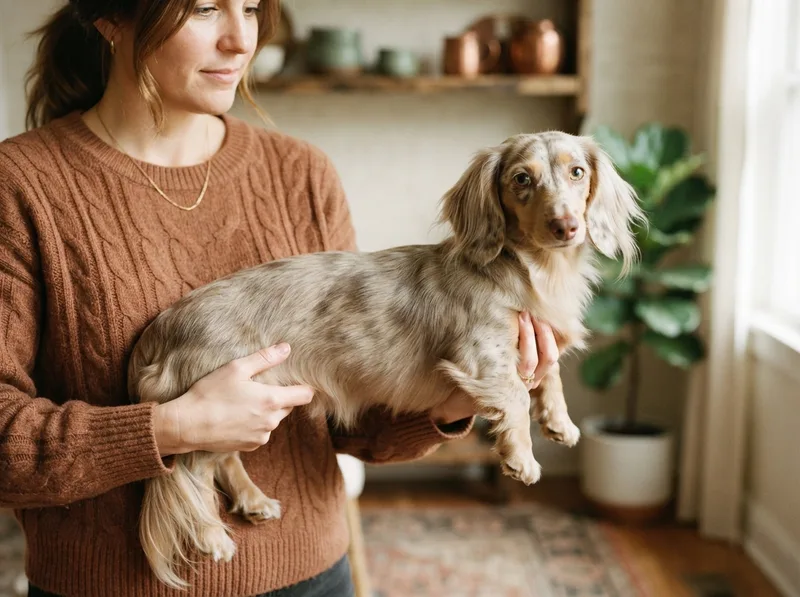
The biggest is weight. Extra kilograms multiply load on compromised discs, which makes keeping your Dachshund lean the single highest-value habit an owner controls. The rest is mechanical: walk on a Y-shaped harness so no force lands on the neck and spine, put ramps where furniture is allowed, keep full staircases out of the daily routine, and build a no-jumping culture from week one, when it is a norm rather than a negotiation.
Round it out with traction and fitness: non-slip runners over tile and marble (a scrabbling landing is a bad landing), and steady sniffy walks that build the core muscle a spine leans on. The room-by-room version lives in the back-safe home setup guide.
The back-safe five
- Lean weight, always: the #1 controllable factor
- Y-shaped harness on every walk, never a collar jerk
- Ramps to sofa and bed; jumping off is the classic injury
- Skip full staircases; carry with two hands, spine level
- Non-slip flooring paths + daily core-building walks
If it happens: treatment in Singapore
Treatment splits by severity. Dogs still walking with pain are usually managed conservatively: strict crate rest for 4 to 6 weeks with anti-inflammatory and pain medication, and many recover fully this way. Dogs with severe or fast-moving signs need imaging (MRI or CT) and potentially surgery, most commonly a hemilaminectomy to clear the disc material off the cord; success rates are good when surgery happens quickly, which is why the run-now list above exists.
Singapore has the full ladder: 24-hour emergency vets for the run-now moment, referral hospitals with advanced imaging and surgical capability, and structured rehabilitation afterwards, including facilities like RehabVet Clinic that run hydrotherapy and physio programmes for spinal patients. Ask your regular vet today, before you need it, which emergency hospital they refer spinal cases to; write it inside a kitchen cupboard door.
The money conversation, plainly: the ivdd surgery cost question has an uncomfortable answer here. Conservative management typically runs hundreds to low thousands; imaging plus spinal surgery in Singapore commonly reaches five figures. This is why insurance taken out while your puppy is young and symptom-free, before anything touches the medical record, is the financially serious move for this breed.
| Severity | Typical path | Cost reality |
|---|---|---|
| Pain, still walking | Strict crate rest 4-6 weeks + medication, recheck | Hundreds to low thousands |
| Weakness, wobbling | Urgent vet, imaging, surgery decision within hours | Imaging + surgery: often five figures |
| Paralysis, no deep pain | Emergency surgery, guarded outlook, rehab | Five figures + rehab programme |
| After any episode | Rehab: hydrotherapy, physio, controlled return | Per-session; often insurance-claimable |
Crate rest without losing your minds
Conservative treatment sounds easy until you try to keep a badger hound nearly motionless for six weeks. The dogs that heal are the dogs whose humans win this boring war, so set it up to be winnable: a crate or small pen just big enough to stand and turn, water fixed to the side, traction matting underfoot, and carried toilet trips on the two-hand hold, nothing more.
Fill the brain since you cannot fill the legs: lick mats, frozen stuffed toys, snuffle boxes at floor level, chew projects, and the radio on when you leave. Expect protest vocals in week one, a strange calm by week three, and do not be fooled by week four’s apparent recovery into ending rest early; the recheck, not the tail wag, ends crate rest. The survival manual is in the crate rest recovery guide.
Screening, breeding and what a buyer can ask
In the UK, the Kennel Club and Dachshund breed clubs run an X-ray screening scheme that grades breeding dogs for early disc calcification, aiming to breed the risk downward over generations. It is a breeder programme, not a puppy test, and it is not yet standard practice in Singapore’s market; claiming otherwise would be selling you a story.
What we actually provide with every puppy, stated plainly: a vet health check, vaccination records, microchip and breed identification, plus the honest briefing this page condenses and a care advice line for the dog’s lifetime. What any buyer can ask any seller: both parents’ ages and back history, the puppy’s weight curve, and how the shop briefs buyers on the back. Sellers who answer in detail are advising you; sellers who wave it away are not.
Ask any seller, including us
- Both parents’ ages and any back history
- What back guidance do you give buyers at handover?
- What aftercare exists if something goes wrong?
- Vet records, microchip, vaccination dates, in writing
Life with the back, honestly good
Here is the part the scary pages skip: a Dachshund with a well-run back lives like any other dog, just with better furniture accessories. Most never have an episode. Recovered dogs hike, swim and thieve food with full conviction. Even wheels-assisted Dachshunds routinely rank among the happiest dogs their vets see.
Design the flat, keep the waist, learn the run-now list, and then enjoy the actual dog: the comedy, the courage, the burrowing. That is the deal with this breed, and stated honestly, it is a very good deal. Our care advice line stays open for every back question you will ever have, starting before you buy.
Fear is not the assignment; preparation is.
Frequently asked questions
Is it common for Dachshunds to get IVDD?
Breed councils estimate around 1 in 4 Dachshunds are affected at some stage, with first episodes most common between ages 4 and 7. It is the breed’s defining health topic, which is why we brief every buyer before purchase.
Can a Dachshund recover from IVDD?
Yes, very often fully. Milder cases recover with strict crate rest and medication; severe cases can do well with prompt surgery. Speed matters: sudden weakness treated within hours has the best outcomes.
How do I reduce my Dachshund’s IVDD risk?
Keep the weight lean, walk on a Y-shaped harness, use ramps instead of jumps, avoid stair routines, and add non-slip flooring. These reduce risk; nothing prevents IVDD, and no honest seller promises otherwise.
What are the emergency signs?
Sudden wobbly walking, hind legs crossing or dragging, inability to stand, crying on movement, or loss of bladder or bowel control. Any of these means an emergency vet immediately, carrying the dog with the spine level.
What does IVDD treatment cost in Singapore?
Conservative management typically runs hundreds to low thousands; imaging, surgery and hospitalisation combined commonly reach five figures. Insuring your puppy early, before symptoms, is the practical answer.
Do Miniature Dachshunds get IVDD too?
Yes. The cartilage gene, not the body length or size class, drives the disease, so Miniatures follow the same back-safe rules as Standards.
How long do Dachshunds with IVDD live?
Usually a normal span. IVDD is managed, not terminal, and dogs recover to full lives; even wheels-assisted dogs commonly live happily for years.
Are your puppies IVDD-screened?
Screening schemes are X-ray programmes for breeding dogs, run in the UK; no puppy test exists. We provide the vet health check, vaccination records, microchip, breed identification, and the honest back briefing every Dachshund buyer deserves.
Meet your Dachshund
Come say hello at Balestier
2 Balestier Road #01-701, Singapore 320002 · Weekdays 12pm–6pm · Weekends 10am–6pm. Or message us first: tell us about your home and routine, and we'll tell you honestly if a Dachshund fits.
Set the flat up back-safe
Ramps, flooring, harness and the no-jump culture, room by room, before the puppy arrives.
Back-safe setup guide