Breed fit · Age-banded honesty
Are Dachshunds Good Family Dogs?
Yes, no, and it depends, sorted by the age of your youngest: the honest family answer this breed deserves, with the four house rules that make the yes reliable and the placement patterns that predict the outcome.
Nelson and Kim, Curious Tails · AVS licence AS24J00046
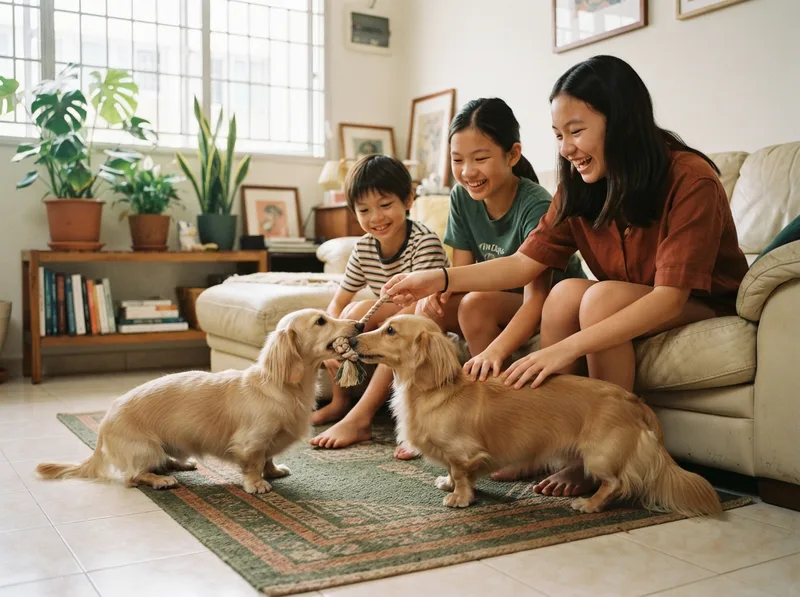
Are Dachshunds good family dogs?
With school-age children (roughly 5 to 12), genuinely yes: devoted, playful and sturdy-hearted, provided four house rules are installed: kids never pick the dog up, ramp rules apply to all, sleeping and eating dogs are off-duty, and play stays on the floor. With grab-stage toddlers, the honest answer is usually to wait: the small back and small hands are a risk in both directions.
The age-banded answer
The are dachshunds good family dogs question has three honest answers wearing one question mark, sorted by the youngest human in the household. Toddler band (0-4): caution, and usually wait, because toddlers and dogs of this build mix badly: a grab-stage child and a small back-fragile dog is a risk running in both directions: the child can genuinely hurt the dog with an enthusiastic grab or a wrong lift, and a hurt Dachshund is honest about its objections. We say this at enquiry and mean it: most toddler households do better waiting a year or two.
Primary band (5-12): school age kids are the sweet spot, and some of our happiest family placement outcomes. Children old enough to learn and keep rules meet a dog sturdy-hearted enough to adore them: playful, patient with commotion, endlessly entertained by humans who drop food and throw things. Teen band and up: functionally adult households with bonus walkers, and the dog will run a personalised affection ledger for every family member, updated daily at dinner.
0-4
Grab stage: usually wait
5-12
The sweet spot band
13+
Bonus walkers acquired
1
Set of house rules, taught to all
The child house rules, taught like seatbelts
Dachshund with kids success is not chemistry; it is child dog rules installed with seatbelt seriousness, back safe handling kids learn once and keep, because the breed’s back turns ordinary kid enthusiasm into physics problems. Rule one: children do not pick the dog up. Not briefly, not carefully, not for photos: the two-hand carry is an adult skill, and the compromise is cuddles delivered at floor level, where this breed prefers its affection anyway.
Rule two: the sofa rules apply to everyone: the dog uses its ramp, and nobody lifts it up or, worse, encourages the flying dismount for a game. Rule three: sleeping and eating dogs are off-duty: the crate and the food bowl are embassy territory, no reaching in. Rule four: gentle play happens on the floor, with the back-safe games from the play guide, not wrestling, not chase-the-dog-around-furniture, and always under adult supervision in the early months. Four rules, one family meeting, refreshed for visiting cousins every single time; respect training for the humans, essentially, and it works.
The four rules on the fridge
- Kids never pick the dog up; floor cuddles instead
- Ramp rules apply to everyone, no lifting games
- Sleeping and eating dogs are off-duty: no reaching in
- Play on the floor, back-safe games only
What the dog brings to the family, honestly both ways
The credit side of good with children: this is a devoted, comic, sturdy-spirited companion that treats family life as the best show in town, supervises homework from lap altitude, and teaches responsibility in walk-sized units, kids walking the dog being the classic starter duty. The debit side, stated with equal volume: the bark will feature in every video call, the potty timeline will test everyone’s patience for months, and the food obsession means unattended school snacks are donations.
One more honest line the brochures skip: a Dachshund typically ranks its humans, openly. It will love the whole family and still elect a favourite (usually whoever runs meals and walks), which sensitive children deserve warning about before the election results come in. The fix is participation: children who feed, train and walk climb the ledger fast, and the ranking reshuffles happily for the rest of the dog’s life.
Unattended school snacks are donations.
The family setups that thrive, and the ones that strain
Across our placements, the family dog outcomes cluster predictably. Thriving setups: primary-age kids with a parent home part-time, steady family routines, families who did the rules meeting before homecoming, households where children joined the training lesson (kids are outstanding trainers once shown the treat timing), and families who chose the calmer puppy from the litter rather than the cannonball their kids campaigned for.
Straining setups: toddler households that skipped the wait advice, homes where the dog became one parent’s fifth job because the family rules never got taught, and chaotic households running the chaos-plus-cannonball combination, where the most excitable puppy met the most excitable family and everyone amplified everyone. The fix in every straining case was the same retrofit: rules meeting, routine, and the training lesson finally spent. Cheaper installed early, per the first week guide.
The verdict, and the honest alternatives
So: are dachshunds good with kids? With primary-age and older children who learn four rules, genuinely yes, and memorably so: the breed’s comedy and devotion land hardest with children, who negotiate with it as an equal and are not wrong. With toddlers, honestly wait, and we will happily say when your household’s timing is right rather than sell into the wrong year.
If the family profile leans differently, the honest alternatives from the comparison hub: the Beagle for maximum kid-tolerance in private housing, the Shih Tzu for gentler younger-child households wanting calm over comedy. And when the band and the rules line up, meet the candidates: the temperament page first, then the cards, then the viewing where your children discover what a big dog in a small body actually means in person. Bring the kids; the interview runs in both directions, and the dog is the better judge.
Frequently asked questions
Are Dachshunds good with kids?
With school-age children who learn the house rules, genuinely yes: playful, devoted and sturdy-hearted. With grab-stage toddlers, the honest advice is usually to wait a year or two.
What age of children works best?
The 5-to-12 band is the sweet spot: old enough to keep rules, young enough to be the dog’s favourite entertainment. Teens add bonus walkers to a functionally adult household.
What rules must children learn?
Four, seatbelt-serious: never pick the dog up, ramp rules for everyone, sleeping and eating dogs are off-duty, and floor-level back-safe play only. Refresh for visiting cousins every time.
Can my 10-year-old walk the dog?
On the Y-harness, with an adult until both ends of the lead are reliable, then yes: a 5kg Miniature is one of the few breeds a primary schooler can genuinely manage, prey-drive lunges included with practice.
Will it guard food from kids?
Resource habits are trainable and worth training early: adults handle bowl-adjacent lessons, children simply never reach into meals. Guarding that persists gets the trainer, not a family workaround.
Should we wait until the kids are older?
If anyone is under about four, usually yes, and we say so at enquiry. The breed will still be wonderful in two years; a bad first year is avoidable now.
Meet your Dachshund
Come say hello at Balestier
2 Balestier Road #01-701, Singapore 320002 · Weekdays 12pm–6pm · Weekends 10am–6pm. Or message us first: tell us about your home and routine, and we'll tell you honestly if a Dachshund fits.
Meet the family candidate
The temperament honestly drawn, then this week’s puppies.
The temperament page