Colour guide · Health notes included
Dachshund Colours in Singapore
Cream to chocolate, dapple to brindle: the breed's palette is wide, and a few of its prettiest swatches come with health strings no listing mentions. Here is the whole map, strings and all, plus the colours that actually appear on our cards.
Nelson and Kim, Curious Tails · AVS licence AS24J00046
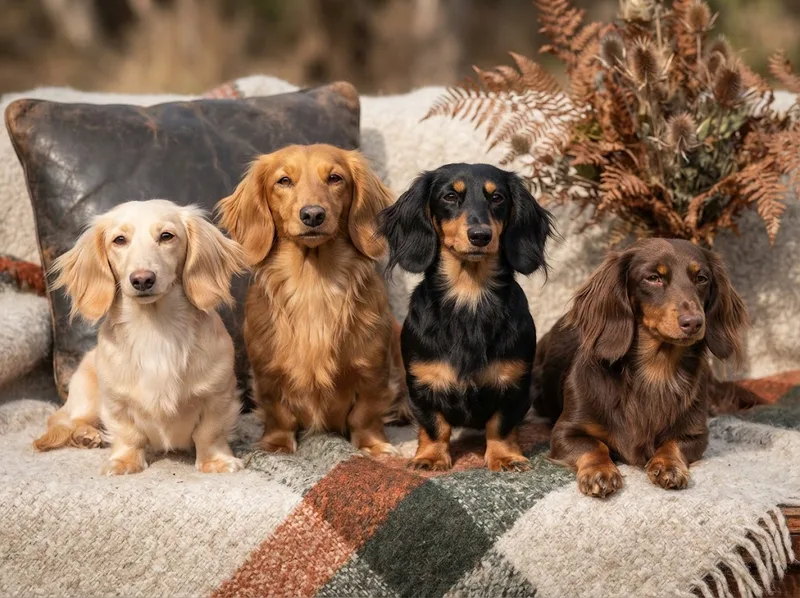
What colours do Dachshunds come in?
Solid reds and creams (including the golden shades), two-tone black & tan and chocolate & tan, dilute blue and isabella, and patterns including dapple, piebald, brindle and sable. Most are health-neutral; the honest exceptions are the dilutes (colour-dilution alopecia risk) and double-dapple breeding (deafness and blindness risk), which is why we place the safe palette and skip the "rare" premiums.
The full colour map, health notes included
Most dachshund colours pages give you a list; none give you the column that matters. Here is the map with health notes attached, because in this breed a few colours come with strings, and a buyer deserves to see the strings before the swatch.
| Colour / pattern | The look | Health notes | We place? |
|---|---|---|---|
| Red | The classic solid, chestnut to deep rust | None | Yes (as golden/red) |
| Cream / golden | Pale gold to rich wheat shading | None | Yes, most requested |
| Black & tan | The iconic two-tone with tan points | None | Yes |
| Chocolate & tan | Brown base, warm tan points | None | Yes |
| Single dapple | Marbled patches over any base colour | Safe with one non-dapple parent | Yes, occasionally |
| Double dapple | Heavy white, often blue eyes | Deafness, blindness, eye defects | Never |
| Blue / isabella (dilutes) | Steel-grey or lavender-taupe | Colour-dilution alopecia risk | No |
| Piebald | White with colour patches | Fine in moderation; extreme white = caution | Not currently |
| Brindle / sable | Striped overlay / dark-tipped hairs | None | Rarely seen here |
The solids: red, golden and the cream family
The red family carries most of the breed’s history and most of Singapore’s demand. Classic red dachshund coats run from bright chestnut to deep rust; what local buyers call golden is the same red family in its warmer, lighter shadings, and it is one of our two most requested colours.
A disambiguation the search engines need: a golden dachshund is a purebred Dachshund in a golden-red coat. It is not a golden retriever cross; those mixes exist and populate half the image results, but they are a different, larger animal entirely. If an ad shows a "golden dachshund" over 6kg with a retriever face, you have found a mix wearing a keyword.
The cream dachshund completes the light end: a soft, pale coat especially glorious in long hair, where the feathering catches it like late-afternoon light. Creams often shift shade through the first year, settling by 12 to 18 months, and the "English cream" version of the story is decoded honestly in the long-haired guide including cream lines.

The two-tones: black & tan, chocolate & tan
The black and tan dachshund is the breed’s postcard: jet base with precise tan points over the eyes, muzzle, chest and feet. On a smooth coat it looks lacquered; on a long coat the tan feathering adds flourish. The chocolate and tan dachshund swaps the jet for warm brown and usually brings amber eyes along.
Both are standard, healthy, string-free colours, and both photograph less in Singapore listings than they deserve, simply because local demand runs light. On our cards they appear steadily but in smaller numbers than the creams and goldens, which is demand talking, not health.
A small buying tip for the two-tones: check the tan points on the parents, not just the puppy. Crisp, well-defined points at eight weeks usually deepen handsomely; smudged or sooty points stay that way. Neither is a fault in a companion dog, but knowing which you are getting beats being surprised at the one-year photos.
The dilutes: blue and isabella, and why we pass
The blue dachshund (steel-grey) and isabella dachshund (lavender-taupe) are dilute versions of black and chocolate, and social media adores them. The dermatology literature is less romantic: dilute coats carry a risk of colour-dilution alopecia, a lifelong condition where the diluted hair shafts are structurally weak, breaking and thinning into patchy loss and chronically irritable skin.
Not every dilute develops CDA, and affected dogs live full lives with managed skin. But breeding toward a colour whose known tax is a lifetime of dermatology is not a trade we will sell, so blue and isabella do not appear on our cards, a stance consistent with Dachshund Health UK colour guidance and with the wider health picture in the health hub.
Dilute colours: the strings
- Blue and isabella carry colour-dilution alopecia risk
- CDA = weak hair shafts, patchy loss, chronic skin care
- Not every dilute is affected; the risk is the point
- "Rare blue, premium price" is the red flag phrased as a feature
The patterns: dapple, piebald, brindle and sable
Patterns overlay the base colours. Dapple, the breed’s merle, marbles lighter patches over any base and is entirely safe in a single dose, one dapple parent, one not; the genetics, the beauty and the hard line against double-dapple breeding get their own full page at the dapple guide and the double-dapple line.
Piebald paints white over a coloured base and is fine in moderation, with caution rising as the white spreads toward the ears and eyes. Brindle stripes the tan points; sable tips red hairs in black. Both are uncommon in Singapore and neither carries health strings; they are simply rare sightings rather than rare treasures.
Pure black, pure white and other unicorns
Two "unicorn" ads deserve decoding. A pure black dachshund, no tan points at all, is genetically improbable in the breed; most such ads are black and tans whose points are minimal or hidden, or crosses. Nothing dangerous, but you are paying a rarity premium for a lighting condition.
A pure white dachshund is the more serious flag: solid white in this breed usually means extreme piebald or, worse, a double dapple stripped of visible dappling, with the associated hearing and vision risks riding along. White with blue eyes in an ad is a walk-away signal, not a collector’s item. Rarity in dog colours is usually a warning label wearing perfume.
Rarity in dog colours is usually a warning label wearing perfume.
Colour pricing, honestly
Our colour economics fit in one sentence: every colour we place prices inside the same published $4,288 to $4,888 all-in band, with single dapples at the top and nothing beyond it. No colour we refuse exists at any price, and no "rare colour" surcharge will ever appear on a card, because charging premiums for dilutes and heavy-white patterns funds exactly the breeding the health notes above warn about.
And to retire the last myth while we are here: colour does not set temperament. The dapple-mischief folklore is owners joking; the cream-gentleness theory is confirmation bias in a pale coat. Parents and socialisation write the personality; the colour writes the photographs.
The colours on our cards
Our palette runs deliberately light: cream and golden first, black and tan and chocolate and tan steadily, single dapple occasionally, all on Miniatures, all inside the band. See what is wearing which colour this week on the available puppies page, and if your heart is set on a specific colour-coat combination, say so; honest wait times beat wishful listings.
Frequently asked questions
What is the most common Dachshund colour?
The red family, worldwide and historically. In our Singapore placements, cream and golden lead demand, followed by black and tan and chocolate and tan.
Is a golden Dachshund purebred?
Yes: golden is warm red-family shading on a purebred Dachshund. Golden retriever crosses are a different, larger dog that borrows the keyword in listings.
Are blue Dachshunds rare and valuable?
They are rare partly because responsible breeders avoid dilutes: blue and isabella carry colour-dilution alopecia risk. A premium price on a dilute funds the problem.
Do puppy colours change?
Shading shifts through the first year, especially in creams and reds, settling by 12 to 18 months. Pattern and base colour do not change; intensity does.
Does colour affect temperament?
No. Dapple mischief and cream gentleness are folklore; parents and socialisation set the character, at every colour.
Why is there no rare-colour premium here?
Because the "rare" colours either carry health strings we refuse to sell or are ordinary colours in unusual lighting. One published band, every colour we place, no exceptions.
Meet your Dachshund
Come say hello at Balestier
2 Balestier Road #01-701, Singapore 320002 · Weekdays 12pm–6pm · Weekends 10am–6pm. Or message us first: tell us about your home and routine, and we'll tell you honestly if a Dachshund fits.
Drawn to the dapple?
The pattern deserves its own honest page: single-dapple beauty, double-dapple truth.
Read the dapple guide