Back-safe living · Guide 1 of 6
Back-Safe Home Setup for a Dachshund
One Saturday of furniture logic buys a decade of quiet risk reduction. Here is the room-by-room version of dachshund ivdd prevention: what to buy, where to put it, and the carrying technique every visitor learns at your door.
Nelson and Kim, Curious Tails · AVS licence AS24J00046
How do I make my home back-safe for a Dachshund?
Five moves: a ramp at every allowed sofa or bed, non-slip runners over tile traffic lanes, a Y-shaped harness instead of any collar pressure, a strict no-jumping-off-furniture rule agreed by the whole household, and lean weight kept with measured meals. This reduces IVDD risk meaningfully; nothing eliminates it, and anyone promising prevention is selling.
Living room: where the risk actually lives
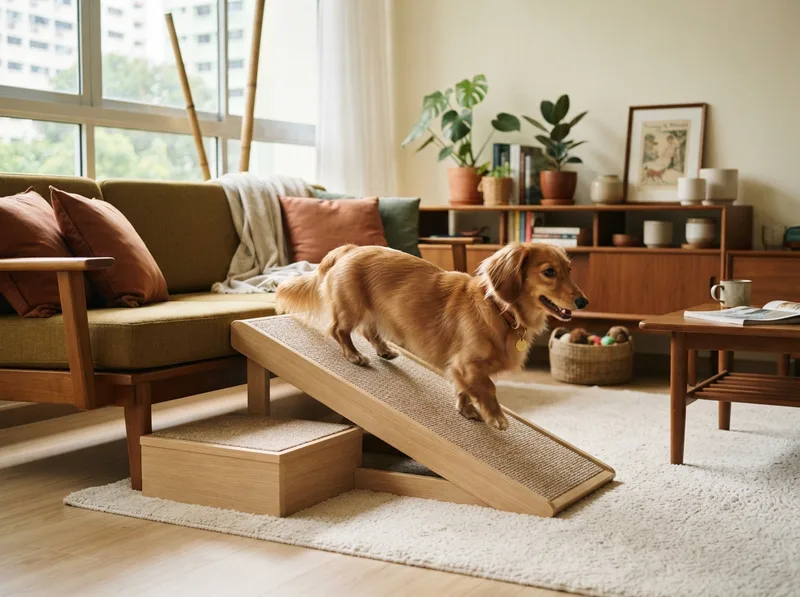
Most disc injuries happen at the sofa, because the sofa is where the jumping happens twenty times a day. The back safe home starts here with a dog ramp: a proper ramp or foam steps at the dog’s preferred corner, taught before jumping becomes a habit, and a family agreement that the no jumping rule applies even when the puppy looks at you like a lawyer finding a loophole.
Flooring is the quiet half of ivdd prevention. Tile and marble are standard-issue in Singapore flats and terrible under scrabbling paws: every slipping landing is a micro-jolt through the spine. Run non slip flooring in the traffic lanes: rug runners, foam mats or carpet tiles from the sofa to the water bowl, and suddenly the dog corners like it has brakes.
If a renovation is anywhere on your horizon, this is the rare dog advice with a contractor angle: choose matte, higher-friction finishes over polished stone in the rooms the dog will live in. Ten years of traction beats any rug budget.
Living room checklist
- Ramp or steps at the sofa corner the dog actually uses
- Rug runners on every tile traffic lane
- No-jump rule agreed by every human
- Water bowl on matting, not marble
- Renovating? Choose matte, grippy finishes
Bedroom, kitchen, doorway: the rest of the flat
The bedroom decision is binary: either the bed is dog-accessible by ramp with the same training as the sofa, or it is off-limits entirely. Crate placement belongs here too: the sleeping crate or pen sits on matting against a wall, out of aircon draught lanes, reachable without a single jump. The worst option is the middle one, where the dog is sometimes lifted up and eventually decides to solve the descent alone at 3am. Sofa height is one thing; a bed drop onto tile is the classic emergency-vet story.
The kitchen contributes through the food bowl and the waistline. Feeding on a non-slip mat keeps mealtimes stable, and measuring meals keeps the single biggest risk factor, weight, under your control rather than the dog’s considerable powers of persuasion. Doorways and the front gate matter for a different reason: a dog that launches itself at the door in excitement is loading its spine with every landing, so calm-greeting training is spine safety wearing a manners costume.
Stairs, where your flat or maisonette has them, get a baby gate. A stairs gate is not forever; it is until the dog is trained to take stairs calmly and rarely, and for many households it simply stays because lifts exist and the badger hound does not pay rent.
Carrying a Dachshund correctly
Every household member, children included, should learn the two-hand carry before the puppy arrives, because a wrongly-lifted Dachshund hangs its own spine like a suspension bridge with no cables. One hand or forearm under the chest, the other supporting the hindquarters, dog held against your body, spine level like a shelf. Down the same way: all four paws to the floor together, never a jump from your arms.
The one-armed scoop, front legs over your elbow with the back half dangling, is how affectionate people hurt dogs they love. Teach the alternative once, enforce it always, and make visiting relatives demonstrate before handover; the dog’s spine does not care how much someone loves dogs.
The carry, in four lines
- One hand under the chest, one under the hindquarters
- Spine level, dog against your body
- All four paws land together; never jump from arms
- Children carry only seated, with an adult, or not at all
The habits that ride along
Hardware is half the setup; habits are the other half. Walk on a harness not collar from the first walk, so no lead correction ever lands on the neck. Keep the weight lean with measured meals and a real treat budget, because extra kilograms multiply disc load daily; the full method lives in the weight management guide. And build core strength the boring way: steady, sniffy walks on varied surfaces, which strengthen exactly the muscles that brace a long spine.
What honest risk reduction cannot do is guarantee anything. Around 1 in 4 Dachshunds meet disc disease anyway, per the breed council figures in the full IVDD pillar, and a perfectly-run flat can still produce an episode, because the driver is the cartilage gene, not your rug budget. The setup buys better odds and, if the day ever comes, a calmer story: a dog that already knows ramps recovers into a flat already built for it.
The pre-arrival shopping and setup list
Everything above compresses into an afternoon and a modest budget. Done before homecoming, it is furniture arrangement; done after a scare, it is guilt-purchasing. The list: one sofa ramp (see ramps that actually work for choosing), rug runners for tile lanes, a Y-shaped harness in puppy size, a baby gate if stairs exist, non-slip mats under bowls, and the family meeting where the no-jump rule and the two-hand carry get agreed by everyone who owns keys.
Total time: one Saturday. Total effect: an hdb flat setup where the breed’s defining risk is quietly managed by the architecture and the furniture rules run themselves, leaving the humans free to enjoy the actual dog.
Frequently asked questions
How do I set up my flat before the puppy arrives?
One Saturday: ramp at the sofa, rug runners on tile lanes, Y-harness in puppy size, baby gate on any stairs, non-slip mats under bowls, and a family agreement on the no-jump rule and two-hand carry.
What flooring is safest for a Dachshund?
High-friction surfaces: rugs, foam mats, carpet tiles over the traffic lanes. Polished tile and marble cause scrabbling landings that jolt the spine; renovators should choose matte finishes in dog rooms.
How high can a Dachshund safely jump?
Treat jumping down as the hazard, and design it out rather than measuring it: ramps at sofa and bed, no launching from arms, calm greetings at doors. The classic injury is one ordinary sofa dismount too many.
How do I carry a Dachshund correctly?
Two hands: one under the chest, one under the hindquarters, spine level, dog against your body, and all four paws set down together. Never the one-armed scoop with a dangling back end.
Does prevention actually work?
Honestly: it reduces risk, it does not eliminate it. The cartilage gene drives IVDD and about 1 in 4 are affected regardless. Lean weight, ramps, harness and traction buy better odds and a safer recovery environment.
What is the single most important habit?
Lean weight, and it is not close. Every extra kilogram loads compromised discs on every step; the waistline is the one factor entirely in your control.
Meet your Dachshund
Come say hello at Balestier
2 Balestier Road #01-701, Singapore 320002 · Weekdays 12pm–6pm · Weekends 10am–6pm. Or message us first: tell us about your home and routine, and we'll tell you honestly if a Dachshund fits.
The pillar behind this guide
The 1-in-4 figure, the emergency signs, and treatment in Singapore, honestly.
Read the IVDD guide