Back-safe living · Guide 3 of 6
Harness or Collar for a Dachshund
The harness vs collar debate ends early when the dog in question carries the most famous spine in dogdom. Here is the physics, the Y-front fitting guide for a long low body, and the one job the collar keeps.
Nelson and Kim, Curious Tails · AVS licence AS24J00046
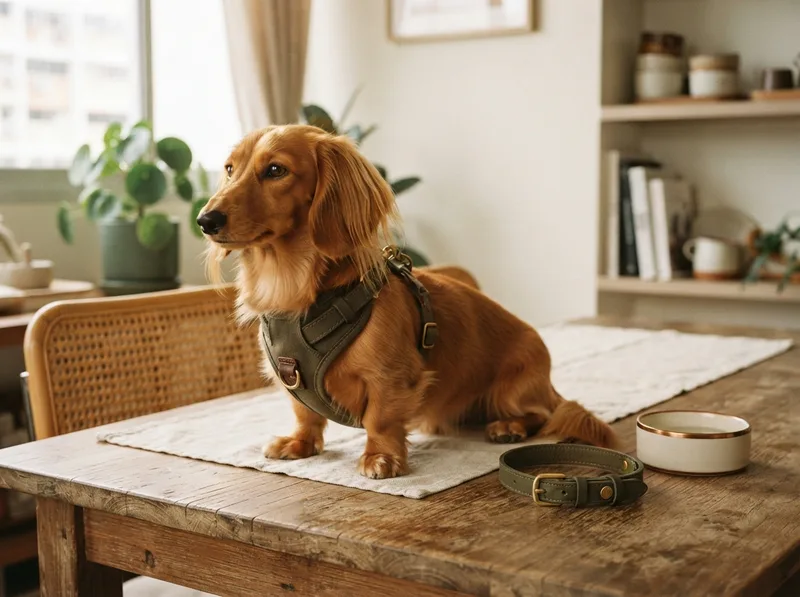
Should a Dachshund wear a harness or a collar?
A Y-shaped harness for every walk: it moves lead forces off the neck, where they load a vulnerable spine and trachea, onto the chest, which is built for them. The collar keeps one job only: carrying the licence tag and ID at home. Fit the harness on chest girth with two fingers of clearance everywhere, and comb the harness line on long coats.
Why the collar loses for this spine
Attach a lead to a collar and every pull, theirs at a mynah, yours at a crossing, delivers force into the neck, where it travels straight down the most vulnerable spine in dogdom. For a chondrodystrophic breed whose discs calcify early (the whole story lives in the IVDD pillar), routine neck pressure is a tax paid on every walk, and trachea sensitivity in small breeds adds a coughing surcharge.
A harness redistributes the same forces across the chest and shoulders, structures built for load. This is not boutique preference; it is the standard recommendation for the breed from rehab practitioners and breed councils alike. The collar is not banned from the wardrobe entirely, though; it keeps one legitimate job, covered at the end.
What Y-shaped means, and why it matters
Harnesses split into two families, and the label rarely helps. The Y-shaped harness runs a strap down the breastbone, splitting around the shoulders like the letter Y viewed from the front: the load lands on the sternum, and the shoulders swing free. The strap-front kind runs a horizontal band across the chest, which sits over the shoulder joints and restricts the front-leg stride, a gait tax a long low body notices.
For a dachshund harness, Y-front is the answer, with soft padding at the sternum plate and harness sizing adjusters at both girth and neck; the chest clip position (sternum, not throat) is the visual check in the shop. The back-clip is the daily driver for this breed; front-clip rings exist for leash-manners training phases, and the flailing-hardware retractable lead pairs badly with a low spine at full sprint, so a flat 1.5 to 2 metre lead completes the set.
The harness spec sheet
- Y-front construction: load on the sternum, shoulders free
- Padded chest plate, adjustable at neck and girth
- Back clip for daily walks; front clip only for training phases
- Flat lead, 1.5 to 2m; retractables pair badly with this spine
- Quick-dry fabric earns its keep in wet season
Fitting a long, low body
Harness fit for a long body fit problem like this one defeats generic sizing charts, because the Dachshund is nobody’s generic: deep-chested, short-legged, long everywhere else. Measure two numbers with a soft tape: the widest chest girth just behind the front legs, and the neck base where the harness will sit. Buy on girth, then judge the fit on the body: two fingers flat under every strap, and a clear two-to-three finger gap behind the front legs, because armpit contact is where friction sores and coat mats begin.
No small-dog harness is truly escape proof, and the escape-artist clause is real in this breed: a scared Dachshund reversing out of a loose harness is a famous party trick. The fix is the girth strap snug (two fingers, not four) and a Y-front whose neck section does not gape. Puppies outgrow settings monthly: re-check the two-finger rule at every month-mark until a year, and expect one full size upgrade between nine weeks and adulthood.
Long-coat owners get one extra chore and one tip, and mat prevention is the chore: the harness line is a mat zone, so comb it at every grooming session, per the long-haired coat guide. The tip: take the harness off at home; a harness worn 24/7 mats the coat underneath it and rubs even good padding into sores.
The collar’s remaining job
None of this fires the collar from the wardrobe; it retires it from the lead. A light id tag collar remains the correct home for the licence tag and an ID disc, worn loose enough to slide two fingers under easily, because a microchip works at the vet while a tag works with whoever finds the dog at the void deck.
The rule that keeps everyone honest: the lead clips to the harness, always; the collar carries identity, only. Walk out the door with that one sentence installed and the equipment debate is finished for the dog’s lifetime, leaving only the pleasant question of which colour looks best against a cream coat. The rest of the pre-arrival kit lives in the back-safe home setup.
The one-sentence rule
- Lead clips to the harness, always
- Collar carries the tag and ID, only
- Harness off at home; check fit monthly through puppyhood
- Comb the harness line on long coats every session
Puppy start and pulling problems
Start puppy harness wear in week one at home: two minutes at a time with treats, before the first walk ever happens, so the equipment predicts good things rather than restraint. First walks happen after vaccinations complete, by which point the harness is furniture.
And the pulling on lead question, since the harness will be blamed: harnesses do not cause pulling; excitement does, and collars merely punished it into the neck. Teach loose-lead walking the payment way: pressure on the lead means we stop, slack lead means we proceed, treats land at your seam. A food-motivated hound learns the economy quickly, and the front-clip ring is there as a training supplement for the enthusiastic weeks. The wider stubborn-hound method lives in the training pillar; the spine simply asks that whatever you teach, you teach it on the chest, not the neck.
Frequently asked questions
Why is a collar risky for Dachshunds?
Lead forces on a collar load the neck and travel down a spine already compromised by the breed’s cartilage genetics. A harness moves the same forces to the chest, which is built for them.
What is a Y-shaped harness?
One whose front strap runs down the breastbone and splits around the shoulders like a Y: load sits on the sternum and the front-leg stride stays free. Strap-front designs that cross the chest horizontally restrict the shoulders.
How do I measure my Dachshund for a harness?
Two numbers with a soft tape: chest girth just behind the front legs, and neck base. Buy on girth, then fit-check: two flat fingers under every strap, clear space behind the armpits.
What size for a Miniature puppy?
Whatever the girth tape says at purchase, re-checked monthly: puppies typically need one full size upgrade between nine weeks and adulthood. Snug beats loose; this breed reverses out of loose harnesses.
Does the harness cause mats in long coats?
The harness line is a mat zone, managed rather than avoided: comb it at every grooming session and take the harness off at home. A 24/7 harness mats coats and rubs sores.
Should my Dachshund still wear a collar?
Yes, as an identity holder only: licence tag and ID disc on a light, loose flat collar. The lead clips to the harness, always.
Meet your Dachshund
Come say hello at Balestier
2 Balestier Road #01-701, Singapore 320002 · Weekdays 12pm–6pm · Weekends 10am–6pm. Or message us first: tell us about your home and routine, and we'll tell you honestly if a Dachshund fits.
Complete the walking kit
Heat timing, pavement tests and the walk windows that suit a low-slung dog.
Heat rules for walks